All 40 volcanoes in La Garrotxa, ranked by fame
The 40 volcanoes of La Garrotxa ranked by fame, with their shape, quirks, photographic appeal and realistic visitability for better planning.
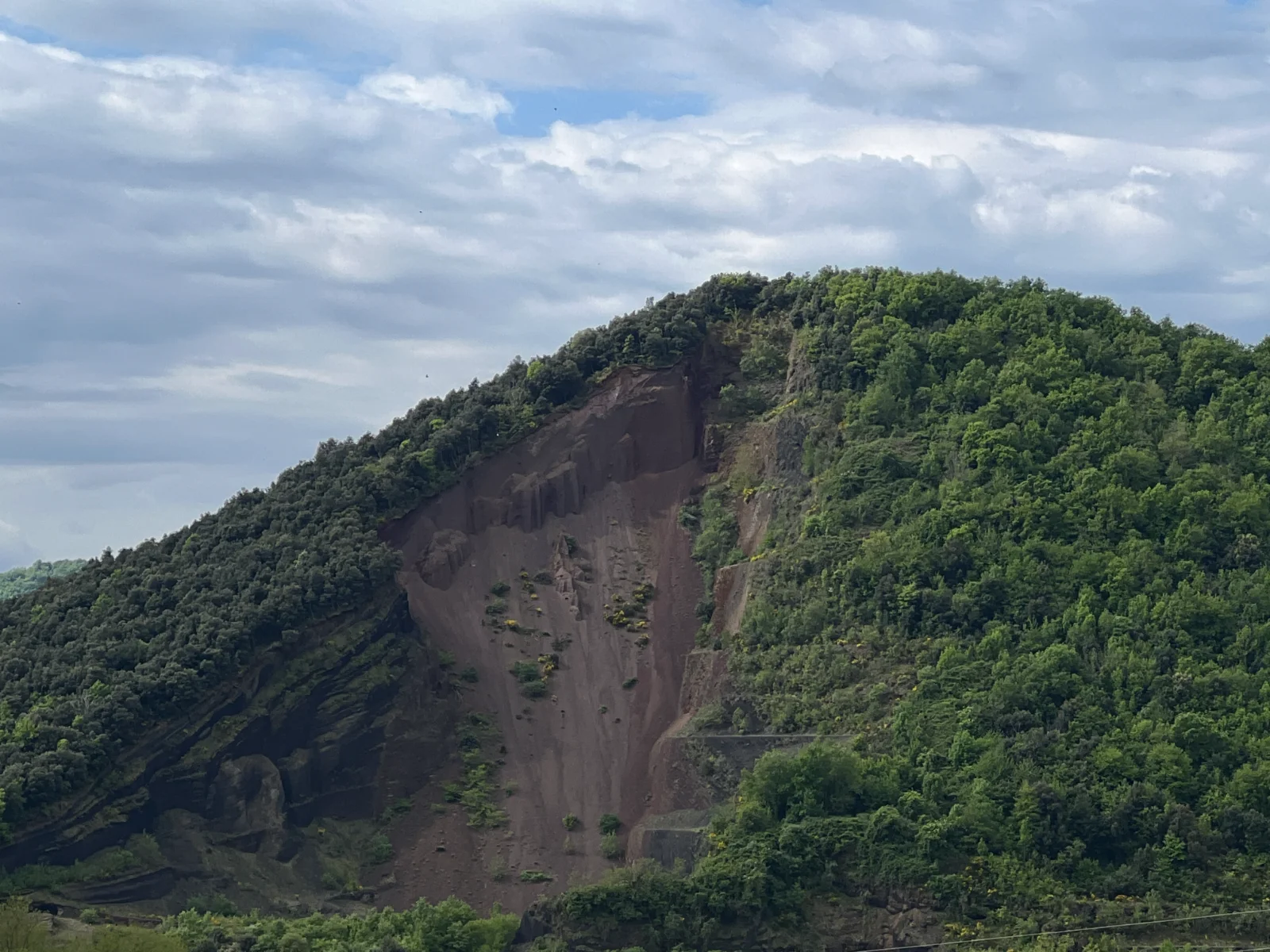
La Garrotxa does not contain forty perfect craters. It has scoria cones, explosion craters, eroded edifices and volcanoes buried beneath younger lava. Some resemble ordinary wooded hills. That is what makes the area interesting.
The Natural Park communicates 40 catalogued volcanoes. We follow that inventory and rank them by approximate visitor fame, not by age, size or scientific importance.
How to read the ranking
Photo is our editorial score for visual clarity and photographic potential. Visit considers public paths, waymarking, interpretation and how easily a visitor can understand the landform. A 1/5 does not mean geologically unimportant; it means we would not make a special trip without a guide, permission or proper context. Current access: [PENDIENTE DE VERIFICAR].
All 40, from most famous to least known
- Volcà del Croscat — A scoria cone with a horseshoe crater and a huge restored quarry cut. Its black and red layers provide the clearest volcanic photograph in the county. · Photo 5/5 · Visit 5/5.
- Volcà de Santa Margarida — A circular phreatomagmatic crater partly excavated into older rock, with a chapel on its floor. Immediately recognisable and predictably busy. · Photo 5/5 · Visit 5/5.
- Volcà de Montsacopa — A regular cone with a centred circular crater directly above Olot. Chapel, towers, urban views and a marked trail make it the easiest volcano to understand. · Photo 5/5 · Visit 5/5.
- Volcà de Montolivet — A Strombolian cone with a crater breached northwest and lava towards the Riudaura. Easy to combine with Olot, although woodland softens its shape. · Photo 4/5 · Visit 4/5.
- Volcà de Rocanegra — A very regular cone with a horseshoe crater open northeast and unusually black pyroclasts. An interpretation site makes the landform easy to read. · Photo 4/5 · Visit 4/5.
- Volcà de la Garrinada — A complex edifice with three craters and alternating Strombolian and hydromagmatic deposits. Scientifically outstanding; frustrating for visitors because access is limited. · Photo 3/5 · Visit 1/5.
- Volcà de Sant Marc — A Strombolian cone beside Sant Feliu de Pallerols. Its former quarry exposes pyroclasts and forms a visitable pair with nearby Puig Roig. · Photo 3/5 · Visit 5/5.
- Volcà del Puig Roig — An edifice associated with a basalt flow exposed in a restored quarry. Less postcard cone, more actual geology in front of you. · Photo 4/5 · Visit 5/5.
- Volcà del Racó — A symmetrical lapilli-and-scoria cone produced by complex Strombolian and phreatomagmatic sequences. It fits well into routes from Les Preses and Xenacs. · Photo 3/5 · Visit 4/5.
- Volcà de les Bisaroques — An urban Olot cone built from scoria and linked to a lava flow. Its outline is easier to recognise from outside than while standing on it. · Photo 3/5 · Visit 3/5.
- Volcà de Fontpobra — An oval cone, crater breached south-southwest, two lava flows and a basalt dyke. · Photo 3/5 · Visit 3/5.
- Volcà de Can Tià — Strombolian activity ended with a phreatomagmatic explosion that opened the crater. · Photo 3/5 · Visit 3/5.
- Volcà d’Aiguanegra — A Strombolian cone breached northwest; its lava helped form the plain beneath Sant Joan les Fonts. · Photo 3/5 · Visit 4/5.
- Volcà del Puig Jordà — A horseshoe cone breached northeast, encircled by the Fageda d’en Jordà lava and later covered by flows from Croscat. · Photo 3/5 · Visit 2/5.
- Volcà de Simon — Water and magma interacted repeatedly before a northwest-breached scoria cone and lava flow formed. · Photo 3/5 · Visit 3/5.
- Volcà del Traiter — A complex edifice with two circular craters and a third horseshoe-shaped crater. · Photo 2/5 · Visit 2/5.
- Volcà de les Medes — A remote system with a scoria cone, breached crater, phreatomagmatic phase and the Llacunagra depression. · Photo 3/5 · Visit 1/5.
- Volcà de Pujalós — An old hemispherical cone with an almost circular base and scientifically interesting rock fragments. · Photo 3/5 · Visit 2/5.
- Volcà del Puig Astrol — The catalogue’s smallest cone: regular, truncated and topped by a tiny central crater. · Photo 3/5 · Visit 1/5.
- Volcans de Cabrioler — Two adjacent cones of similar size, both older than Croscat. · Photo 2/5 · Visit 2/5.
- Volcà de Comadega — A hemispherical monogenetic cone with a centred crater slightly open eastward. · Photo 3/5 · Visit 2/5.
- Volcà del Puig Subià — Pyroclastic deposits squeezed between Rocanegra and serra de Finestres. · Photo 2/5 · Visit 2/5.
- Volcà de la Tuta de Colltort — An oval depression excavated by an explosive phase, followed by a small lava flow. · Photo 2/5 · Visit 2/5.
- Volcà del Puig de Martinyà–Puigsafont — A compound edifice with two elliptical craters and irregular scoria-and-lapilli forms. · Photo 2/5 · Visit 1/5.
- Volcà del Puig de l’Estany — The northern member of three aligned cones; its crater opens north-northwest. · Photo 2/5 · Visit 2/5.
- Volcà del Puig de Bellaire — The southern cone in the Bellaire–Gengí–Estany group, degraded and craterless. · Photo 2/5 · Visit 1/5.
- Volcà de Gengí — The middle cone in the same group, also degraded and without a readable crater. · Photo 2/5 · Visit 1/5.
- Volcà del Puig de Mar — A heavily degraded crater and barely perceptible flow in the Santa Pau basin. · Photo 2/5 · Visit 2/5.
- Volcà del Puig de la Costa — An edifice hidden by vegetation and Croscat ejecta. · Photo 2/5 · Visit 1/5.
- Volcà del Puig de la Garsa — An eroded Strombolian cone with no surviving crater, formed from scoria and lapilli. · Photo 2/5 · Visit 2/5.
- Volcà de Can Barraca — A red pyroclastic cone at Batet containing lapilli, ash and bombs. · Photo 2/5 · Visit 1/5.
- Volcà del Puig de l’Ós — A simple Strombolian cone, crater breached southwest with an associated lava flow. · Photo 2/5 · Visit 1/5.
- Volcà del Cairat — A circular explosion crater excavated directly into a ridge, with no cone, by violent phreatomagmatic activity. · Photo 2/5 · Visit 1/5.
- Volcà del Pla sa Ribera — An edifice without a visible crater, combining phreatomagmatic and Strombolian activity; a small satellite cone remains. · Photo 1/5 · Visit 1/5.
- Volcà de Sant Jordi — An eruptive centre on a steep slope; its precise vent is unknown and no readable crater morphology survives today. · Photo 1/5 · Visit 1/5.
- Volcà de Repàs — A small, deeply eroded Strombolian cone on serra de Molera; its former crater, probably breached northeast, can no longer be recognised. · Photo 1/5 · Visit 1/5.
- Volcà de Repassot — A small Sant Joan les Fonts centre retained in the classic inventory. · Photo 1/5 · Visit 1/5.
- Volcà de Claperols — A small pyroclastic edifice altered by erosion and former extraction. · Photo 1/5 · Visit 1/5.
- Volcà de la Canya — Almost nothing but the summit remains visible above lava flows that buried the cone. · Photo 1/5 · Visit 1/5.
- Volcà del Bac de les Tries — A completely eroded edifice with no crater, identified through small outcrops near Olot. · Photo 1/5 · Visit 1/5.
The ones we would choose first
With one day, do not collect cones. Choose three different experiences:
- Croscat to see the coloured interior of a scoria cone.
- Santa Margarida to walk inside an immediately recognisable crater.
- Montsacopa to understand how Olot and its volcanoes fit together.
Why the total is not quite simple
Recent mapping and research also use names such as la Pomereda, Ca l’Isidret and Puig s’Agonia, while some compound edifices are split or grouped differently. You may therefore find totals above forty. We retain the official catalogue of 40 here so that one visitor guide does not quietly combine several counting systems.
For international readers, gredera means a former extraction site for volcanic cinders or lapilli. Several of the best interpretation points exist because old workings exposed the inside of a cone; restoration made some, but not all, safe and public.
Practical information
- Almost all Natural Park land is privately owned: a marked path does not permit wandering across fields.
- Never enter a quarry, extraction face or crater unless a public route clearly allows it.
- Download the route and check restrictions, parking and reservations before leaving.
- Vegetation radically changes how clearly a cone can be read; winter and early spring often reveal profiles better.
- For volcanoes rated 1/5 or 2/5 for visiting, a specialist guide adds far more than a phone location.
Our verdict
The first three deserve their fame. The list shows that some volcanoes are seen, others must be read and a few only become clear when somebody points to the correct exposure.