La Garrotxa volcano route: Croscat, Santa Margarida and Montsacopa
A practical La Garrotxa volcano route covering Croscat, Santa Margarida and Montsacopa, with access details, walking times and honest local advice.
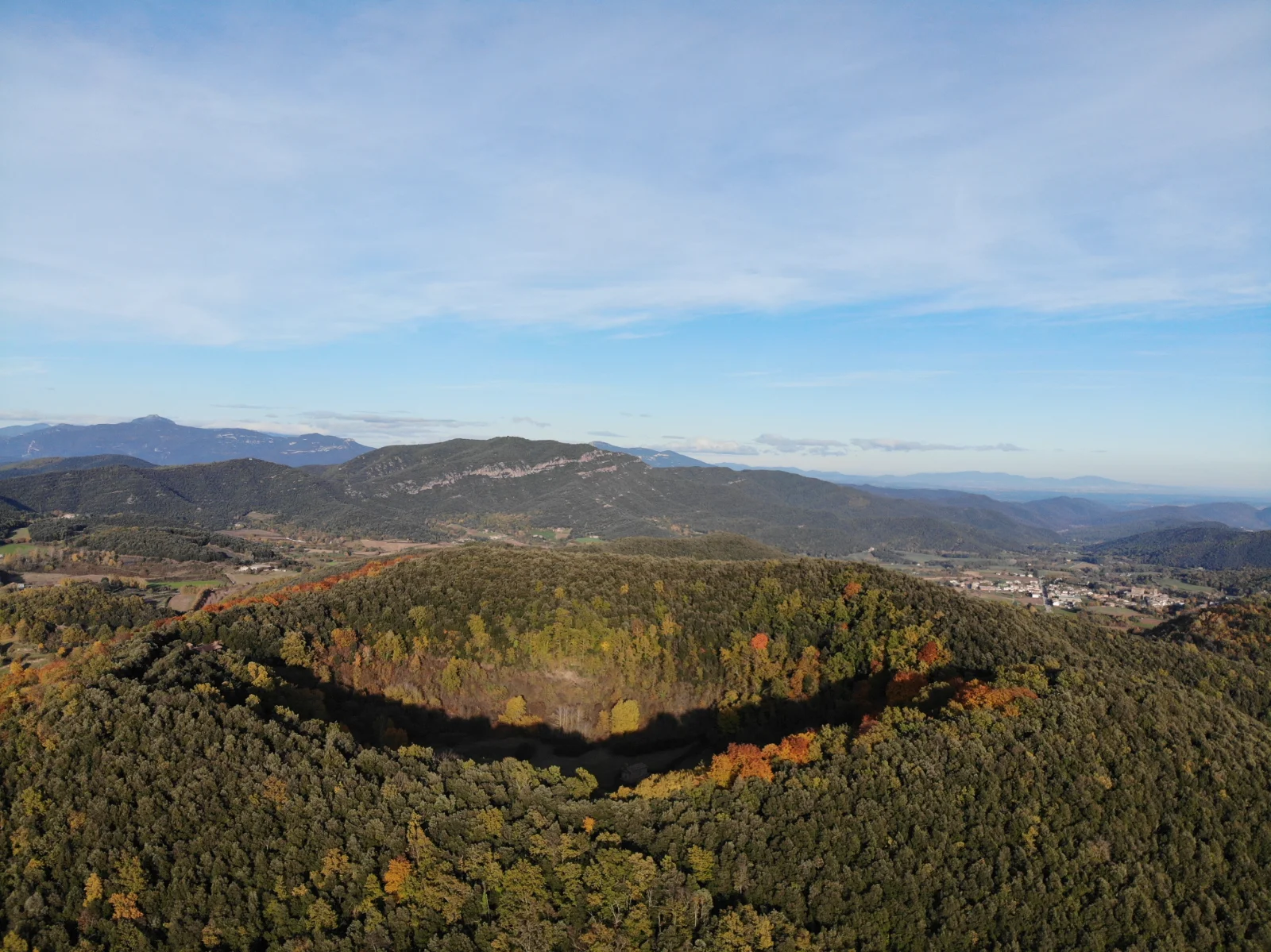
La Garrotxa contains more than forty volcanoes, but you do not need to climb every one to understand the landscape. Many of them barely resemble volcanoes when viewed from ground level.
For a first visit, focus on Croscat, Santa Margarida and Montsacopa. Croscat reveals the inside of a volcanic cone, Santa Margarida has a broad crater containing a small chapel, and Montsacopa rises directly above the town of Olot.
They do not form one continuous walking route. Croscat and Santa Margarida can be combined from the same area of the Parc Natural. Montsacopa is in Olot and requires a separate journey. Trying to connect all three on foot in one morning is an efficient way to stop enjoying volcanoes.
Our recommended route
Spend one morning visiting Croscat and Santa Margarida. Both are reached from the Santa Margarida visitor area on the GI-524 road between Olot and Santa Pau. Afterwards, have lunch or walk around Santa Pau.
Save Montsacopa for late afternoon or the following morning. You can climb it on foot from Olot, and the view works particularly well when the heat drops and the light over the town becomes softer.
To include la Fageda d'en Jordà, follow official circular route number 1. It links the forest, Santa Margarida and Croscat over 10.9 kilometres, with 290 metres of ascent and an estimated walking time of 3 hours and 15 minutes.
Always check the official Parc Natural itinerary before setting out.
Croscat: the open volcano
Croscat does not provide the classic view of a circular crater from above. Its main attraction is the gredera, a former quarry that cut a section more than one hundred metres high into the volcanic cone.
The exposed wall reveals layers of black, grey, red and orange material. The darker rock retains its original colour, while the red and orange areas result from oxidation. It is one of the clearest places to see how a volcanic cone is constructed without imagining everything beneath trees and soil.
Route number 15 begins at the Santa Margarida area and leads to the exposed section, passing close to the Can Passavent information centre. It is a relatively straightforward out-and-back walk.
You cannot see the Croscat crater from this trail. The purpose is to examine the quarry cut, not to find a perfect circular crater with a lake in the middle. Anyone expecting the latter has selected the wrong volcano and possibly the wrong country.
Remain inside the marked visitor area. Do not climb the wall or remove volcanic rocks. Organised groups are subject to specific rules and may need to be accompanied by a guide authorised by the Parc Natural.
Check the official Croscat route.
Santa Margarida: walking into the crater
Santa Margarida looks more like the volcano many visitors expect. An explosive eruption created a broad circular crater, now covered by grass in the centre and forest on the slopes. A small chapel stands at the bottom.
From the visitor area, the path climbs the outer slope before descending into the crater. The walk is not technically difficult, but it has a genuine gradient. Walking down tends to create confidence that the return climb then adjusts.
Wear shoes with decent grip, particularly after rain. The path can become muddy and slippery. With children, allow additional time and avoid describing the return as a completely flat stroll.
The chapel is small, and the crater floor does not provide a sweeping view. The appeal lies in standing inside the volcanic structure and appreciating its scale.
Combining Croscat and Santa Margarida
Park at the Santa Margarida area, visit Croscat first using route 15 and then climb Santa Margarida by following signs for route 1.
Allow roughly half a day for both visits without rushing. The real duration depends on your pace, stops and trail conditions. Carry water and something to eat even though services are available nearby.
Parking is regulated and paid. Current official information says that advance booking is not required, although arriving early is recommended. Check the latest access information before travelling.
Montsacopa: Olot's urban volcano
Montsacopa demonstrates that La Garrotxa's volcanoes are not isolated from its towns. The cone rises immediately beside central Olot, surrounded by streets, homes and businesses. At the top, you can walk around the crater and see the town, mountains and neighbouring volcanoes.
The summit also contains the two Sant Francesc watchtowers, built during the Carlist Wars, and the Sant Francesc church. The towers provide useful viewpoints for identifying Montolivet, la Garrinada and les Bisaroques.
The shortest approach starts at Olot's municipal cemetery car park. The marked route climbs approximately 400 metres and takes around 25 minutes. Walking from the Tourist Office in central Olot takes roughly 45 minutes.
Visitors with reduced mobility who need vehicle access must request permission in advance. Check the official Montsacopa information before your visit.
Do not attempt to drive up without permission simply because a navigation app displays a road. Digital maps are remarkably relaxed about access restrictions they will not personally have to explain.
Which volcano should you choose?
If you only have time for one:
- Croscat is best for understanding geology and seeing volcanic materials.
- Santa Margarida offers the experience of walking into a recognisable crater.
- Montsacopa provides a shorter visit, wide views and easy access from Olot.
For younger children, Croscat is generally easier than the complete Santa Margarida climb. Montsacopa suits families accustomed to walking, although being inside a town does not remove the slope.
When to go
Spring and autumn normally provide the most comfortable walking temperatures. In summer, start early because sections of the volcanic slopes are exposed to the sun. Rain can leave the paths muddy and slippery.
During autumn, visitors heading to la Fageda d'en Jordà fill the same parking areas early. Arriving before the main crowds remains more effective than hoping for an unexpectedly empty space.
The verdict
Croscat, Santa Margarida and Montsacopa do not repeat the same experience. One exposes the inside of a cone, another lets you enter a crater and the third explains the relationship between Olot and its volcanic setting. Visit the first two together and save Montsacopa for late afternoon. Three volcanoes are enough to begin; collecting the rest can wait.