La Garrotxa in 2 days: a realistic weekend itinerary
A realistic 2-day La Garrotxa itinerary with volcanoes, villages and honest local advice, designed for a full weekend without rushing everywhere.
Two days are not enough to see all of La Garrotxa, but they are enough to understand why people return. The usual mistake is trying to combine volcanoes, medieval villages, mountain hikes and a natural pool before driving home on Sunday afternoon.
This itinerary is intended for a first visit, using a car and staying in Olot or nearby. Day one focuses on the volcanic area. Day two combines Olot with Castellfollit de la Roca and Besalú. It is a full weekend, but it should not feel like a competition against Google Maps.
Where to stay and how to get around
Olot is the most practical base. It is close to the main volcanic sites, has the widest choice of restaurants and accommodation, and allows you to begin the second day on foot. Santa Pau is a quieter alternative if you would rather stay near la Fageda d'en Jordà.
La Garrotxa has no railway station. Buses reach Olot and some other towns, but a car remains the most flexible option for this particular route. Once you reach each area, park properly and explore on foot instead of driving every possible kilometre.
Bring shoes with decent grip, water and something waterproof. The ground inside the Fageda can remain damp even when the car park looks entirely dry.
Day 1: la Fageda d'en Jordà, Croscat and Santa Pau
The official circular route through the Parc Natural links la Fageda d'en Jordà, the Santa Margarida volcano and the Croscat volcano. It covers 10.9 kilometres, with 290 metres of ascent and an estimated walking time of 3 hours and 15 minutes, excluding long stops.
You can start at the Can Serra area beside la Fageda d'en Jordà or at the Santa Margarida area. Both are on the GI-524 road between Olot and Santa Pau. Check the official Parc Natural itinerary before setting out.
Start early in la Fageda. This beech forest grows over an old Croscat lava flow, although the leaves and moss make that easy to forget. The entrance paths attract plenty of visitors, but walking a little farther usually reduces the noise. Autumn brings impressive colours and considerably less reliable solitude.
Continue towards Santa Margarida. The path climbs to the volcano's rim and descends into the crater, where a small chapel stands in the middle. Walking down feels easy. Walking back up provides a useful reminder that craters work in both directions.
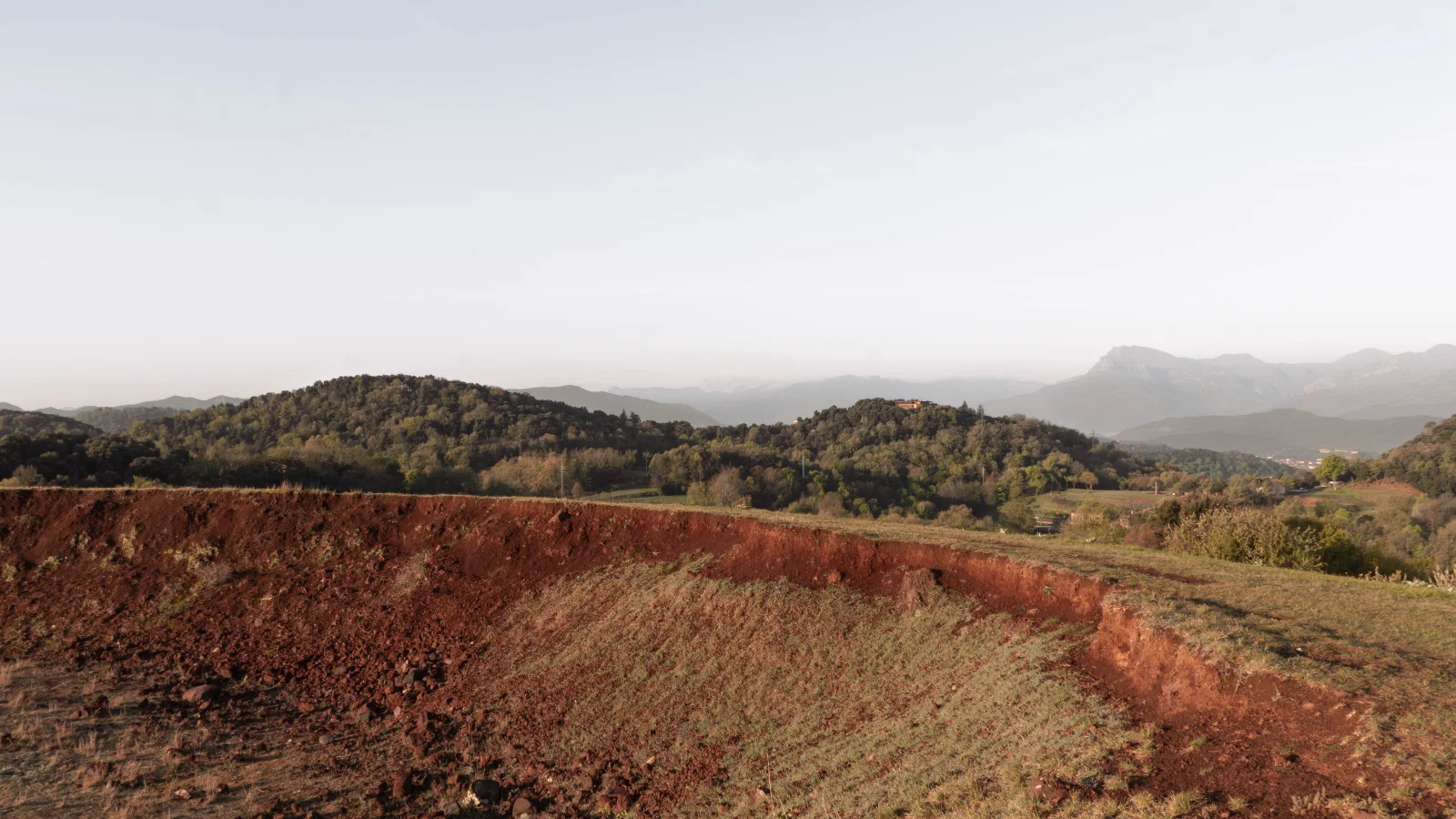
The loop then reaches Croscat. Former quarrying exposed the volcano's inner layers, producing bands of red, black and ochre material. Stay on the marked route, do not climb the exposed slope and leave the rocks where they are.
If a ten-kilometre walk is not your idea of a relaxing weekend, use the shorter version: walk through la Fageda, visit Croscat from the Santa Margarida area and drive to Santa Pau. Skipping the Santa Margarida crater is better than completing the entire route quickly and enjoying none of it.
Have lunch in Santa Pau and book ahead on busy weekends. Look for fesols de Santa Pau, the small local white beans, and dishes based on the region's volcanic cuisine. Remember that lunch is generally later than in northern Europe, but that does not mean every kitchen stays open continuously.
Spend the afternoon exploring the arcaded square, stone lanes and viewpoints around the village. Santa Pau is compact, but it benefits from a slow visit. Do not add Besalú that afternoon simply because your map says the drive is technically possible.
Day 2: Olot, Castellfollit de la Roca and Besalú
Begin in central Olot, around the market and the Firal, before choosing between the Montsacopa volcano and Espai Cràter. You can do both with an early start, but there is no prize for collecting every attraction.
Montsacopa rises beside the town centre. The walk reaches the crater rim and viewpoints over Olot and the surrounding mountains. It makes one point especially clear: volcanoes are part of the town itself, not distant objects kept inside a separate park.
Espai Cràter is the better choice in rain, with children or if you want to understand the landscapes from the previous day. The exhibition building is partly set inside the Puig del Roser volcano. Check the current opening information and tickets before arriving.
Continue to Castellfollit de la Roca. First go down towards the Fluvià to see the village standing on its basalt cliff. Then walk through the old centre to the former Sant Salvador church and viewpoint. The roadside photograph is quick, but it explains the village rather poorly.
Finish in Besalú. Cross the fortified medieval bridge and explore the streets around Sant Pere, Sant Vicenç and the former Jewish quarter. The bridge deserves its reputation, although it is not the only reason to visit. Late afternoon often brings fewer groups and softer light over the river.
This is a fairly busy second day. For a slower trip, choose either Castellfollit de la Roca or Besalú. Besalú has more historic sites and requires more time. Castellfollit is a shorter stop that maintains the volcanic theme of the weekend.
Travelling with children or in wet weather
With younger children, shorten the first day to la Fageda, Croscat and Santa Pau. On day two, combine Espai Cràter, Parc Nou and Castellfollit de la Roca. Families accustomed to walking can complete the full volcanic loop, but it is not a casual pushchair route.
During heavy rain, replace muddy paths with Espai Cràter, Olot or Besalú. Check the official access and reservation information before visiting natural areas, as regulations can change seasonally.
The verdict
In two days, you will see the essential volcanic landscapes, a working local town and three very different villages. The Vall d'en Bas, the natural pools and Alta Garrotxa will remain unseen. That is not a failed itinerary; it is the correct reason to come back.